November 11 2015Learning Polish Words (at LingQ)
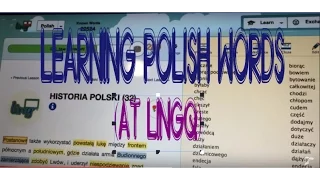
LingQ's free Polish grammar guide: https://www.lingq.com/en/grammar-resource/polish/ My Blog: http://blog.thelinguist.com/ My Facebook Page: https://www.facebook.com/lingosteve My Twitter: https://twitter.com/lingosteve Learn the Polish Alphabet: https://www.lingq.com/blog/2018/12/05/polish-alphabet/ Transcript: Hi. Today I’m going to show you where I work, but before we do that I’ll show you how I accumulate words. I think on my profile at LingQ I have saved about 15,000 words and phrases and my known word count is up to 20-odd thousand. I’ll show you how I do that, but first I wanted to mention a little bit about why it’s fun to learn languages. I’m learning Polish. I’m listening to Piotr’s podcast RealPolish.com and he’s talking about the Chopin Contest in Warsaw. A contest which he tells me takes place once every five years was won by a pianist from Korean; a Canadian came second. So my wife and I are sitting here having dinner which my wife has prepared and I said, wouldn’t it be nice to see on our iPad a video of these pianists from Warsaw. So we’re drinking wine, California wine, we’re watching a Korean pianist, excellent pianist playing Chopin on our iPad, as a result of studying Polish and having Piotr telling me that there was this Chopin piano competition. Anyway, just like this great global world that we live in, we learn so many things by learning languages. Oh, the other thing I should say is I’ve started speaking Polish. I’m using Italki.com because we don’t have enough Polish tutors at LingQ. I’ve had three sessions so far, I’ve got another one tomorrow and I may, in fact, try to record one of them so you can hear me struggling to speak Polish, but now let me show you how I accumulate all these saved words and phrases. I’m learning so much about the history of Poland, the partition of Poland, the _______, the twentieth century, all this kind of stuff that I never knew before. Anyway, let’s have a look. So here I am. I bought this eBook called Historia Polski. I have an audio book on Polish history which doesn’t match this word for word, but has a lot of the same stuff. Here is a lesson. What we see right away is that there is 223 blue words. That is, words that I have not met before. Most of which I don’t know maybe. So if I click on that, I see a list here of all the blue words and there are 289 links or words that I have already saved. Many of which I know, but not all of which. These yellow words then show up as yellow in my text, I go through them and I tend to read it to myself. [Insert Polish], ‘the Russian Army’ [Insert Polish] Now, I know that word. I don’t need it, so I hit K so I don’t have to save it. [Insert Polish] Okay. [Insert Polish] ‘Unexpectedly’, I know this word already. Even though it’s a yellow word, I’m going to hit K. [Insert Polish] I’m not so familiar with that, so I leave it. [Insert Polish] I don’t know what that is. If I’m not sure that it’s a word or a name, I just hit X so I don’t count it in my statistics. [Insert Polish] The left-wing I guess this is. ‘Wing’, I know it, I hit K. [Insert Polish] I didn’t really know that, so I keep that. I keep on hitting the arrow keys and it automatically saves the word. [Insert Polish] I know is ‘threatening’, so I can now remove that. [Insert Polish] I think that means to be surrounded. The word ‘lap’ comes up in Google Translate. I could look it up in a dictionary, but I think it means to be surrounded, so I’m just going to hit Known. It doesn’t matter. [Insert Polish], ‘operations’ [Insert Polish] ‘conducted’ or ‘carried out’ and I leave the months all the time because it’s so hard to remember the months. [Insert Polish] Now, the hint that I get up here is ‘unsuccessful’, but that’s Google Translate. In fact, it means ‘successful’, so I hit Known. [Insert Polish] Now, that’s a word I don’t know. Even though I’ve encountered it before I’ve already forgotten it. Basically, just to show you, I keep on going through. That’s a name, so I’ll take it out of my saved links. Here’s another name, which I don’t save. Oh, I hit K by mistake, so I’ll go back. Not that it matters, I’m not so fussy about my statistics. I hit X to remove it. [Insert Polish] ‘Started’, I know that, but I leave it there just the same. So that’s how I go through quite quickly finding new blue words. [Insert Polish] I know that’s ‘September’, but I’m leaving it. [Insert Polish], I sure don’t know it. [Insert Polish] I know the word for ‘victory’, so I can hit K to remove it. That gives you an idea of how I do it. As a result of doing all of that, over the first two months of my Polish challenge I have learned a great deal about Polish history, I have added probably 20,000 to my vocabulary so it’s built up this passive knowledge and now, tomorrow, if I’m lucky, I will record my discussion with my Polish tutor on Italki and you’ll see how much I’m able to use when I speak. So there you go, a bit of an update on my Polish challenge.
Watch Video